
Welcome - Video Transcript
Hi, I’m Susi from Kingstown Web Studio.
If you’ve landed on this page, you’re probably wondering what AEO actually is - and whether it matters for your business.
The short answer is yes. Quite a lot.
Search has changed.
People aren’t typing keywords anymore. They’re asking real questions - out loud, on their phones, in their cars, in the middle of everything else.
And AI answers them instantly.
Your business is either in that answer - or it’s invisible.
This page explains what’s happening, why small businesses are well placed to benefit, and what you can actually do about it - without a big budget or a marketing team.
You’ll find everything broken into sections you can dip in and out of, including a practical checklist, a framework designed specifically for small businesses, and real examples to help you see your own website differently.
Take your time. It’s all here.
And if you’d like to talk through what it means for your business, you can book a Quick Guidance Call using the link below.
Let’s get into it.
Is Your Website Ready for AI Search?
Not a blog post. Not a theory piece. A working guide to how AI search works - and how to make it work for you.
Search has changed.
People aren’t just typing a few words into Google anymore.
They’re asking full questions in plain language
- and getting direct answers back, with a small number of sources chosen for them.
Your business is either showing up in those answers - or it’s invisible
Every search still starts with a person. A real one, with a real question, usually in a real hurry.
But how they find businesses like yours has changed more in the last two years
than in the previous twenty.
If you already know what you’re looking for, you can jump straight to it below
- or follow the page through step by step.
If you do one thing, make sure your website clearly answers
your customers’ most common questions.

What to do next?
This page was built using the same Answer-Ready thinking
This page isn’t just explaining Answer-Ready - it has been deliberately structured the same way an Answer-Ready website (and pages) should be approached.
Before a single word was written, the intent of the page was mapped:
-
what questions needed answering
-
what order those answers should appear in
-
how much explanation was genuinely helpful
-
where clarity mattered more than detail
Only then was the content written.
That logical, systematic, thinking-ahead approach is what makes Answer-Ready websites work. It’s not about adding fixes after the fact - it’s about structuring meaning properly from the start.
Which one is you or your customer?
Before we go any further, here's a question worth sitting with. Do any of these feel familiar?

The lunchtime scroll
A factory supervisor gets an hour for lunch. She's been meaning to sort out a local accountant for her side business for months. She opens Google and types: "best small business accountant near me." An AI overview appears at the top of the page - a clear, summarised answer with three local firms cited alongside it. She clicks one.
Done before her sandwich is finished.

The school run wait
Parked outside school with fifteen minutes to kill, a mum who runs a small bookkeeping practice needs a new website. She asks Siri: "how much does a small business website cost?" She gets a clear answer before the first child appears at the gate. One of the cited sources catches her eye.
She books a discovery call that evening.

The van moment
A property developer pulls up outside a site needing a structural engineer fast. He says to his phone: "find me a structural engineer in Manchester who does emergency surveys." His phone gives him two names with reasons. He calls the first one. That engineer didn't outspend anyone.
Their website just answered the question clearly.

The late-night worrier
A sole trader electrician is lying in bed at 11pm wondering why his website does nothing. He searches: "why is my website not showing up in search?" Google's AI overview gives him a plain-English answer - and one of the cited sources is a web design studio's blog post that explains exactly what's missing and suggests they can help fix it.
He's reading their website at midnight.
That studio just earned a warm lead while its owner was asleep.
None of those people went to page two of Google. None of them scrolled through ten results. They asked a question, got an answer, and acted on it. If your business was one of the cited sources - you won. If it wasn't, someone else did.
That's what this page is about.

What is AEO?
AEO stands for Answer Engine Optimisation (also written as Answer Engine Optimization in the US).
It is the practice of structuring your website content so that AI-powered search tools can identify it as the best answer to a customer's question and present it directly - often at the very top of Google's first page, or within a ChatGPT or voice search response.
Where traditional SEO focused on appearing in a list of search results on Google or Bing, AEO is about becoming the answer itself.
This is where it starts to click.
What looks like a small shift in search is actually a completely different way of being found.
There are a few things in that definition worth unpacking properly, because the detail matters.
"AI-powered search tools" covers more ground than people realise. It's not just ChatGPT or Perplexity. Google itself - still the search engine the vast majority of people use every day - now features an AI Overview at the top of many results pages. This is a synthesised, written answer pulled from several sources across the web, with those sources cited clearly alongside it. It sometimes sits above paid adverts. It always sits above the traditional list of ten links. It's known as Position Zero - because it comes before everything else.
When your content is cited in a Position Zero answer, something genuinely remarkable happens. Your business can leap from page four, page ten, or nowhere at all - straight to the top of Google's first page. Not because you outspent anyone. Because you answered the question most clearly.
"Being chosen as the answer" is what distinguishes AEO from traditional SEO. AI search tools aren't just looking for pages that contain the right words. They're looking for content that is clearly structured, written in plain language, and specific enough to be genuinely useful to the real person asking. They want content they can trust - and trust means knowing who wrote it, when, and whether the information is current and consistent.
And crucially - people still click. The difference is what they click on. The AI overview arrives first, with cited sources alongside it. The click that follows is a more informed, more intentional one. You're not losing clicks. You're getting better ones - from people who've already read something helpful about your business before they arrive.
Did you know?
More than 60% of Google searches now end without clicking through to a website in the traditional sense - because a direct answer arrives at the top of the page, with cited sources right alongside it. People still click, but the journey has changed: the answer comes first, the click comes second. Being one of the cited sources means your business appears at the top of page one - even if you've never ranked there before.
How has search changed - and what does that mean for your business?
Search hasn't disappeared - it's evolved. Google is still dominant, but it now gives AI-generated answers at the very top of the page, with cited sources alongside them. Meanwhile, tools like ChatGPT, Perplexity, and voice assistants are becoming mainstream ways to find services. The way customers find businesses like yours has fundamentally shifted - and how you show up needs to shift with it.
This is where it really opens up.
To understand where we are now, it helps to understand where we've been.
The old Google game - and why it favoured the big players
For two decades, getting found online meant one thing: getting to page one of Google.
And here's a question worth asking yourself honestly - when did you last go to page two of a Google search?
Research consistently shows that around 75% of people never scroll past page one. Some studies put it higher.
Page one has always been prime real estate.
The most valuable, most contested digital turf on the internet.
And for years, getting there meant a combination of technical expertise, sustained content strategy, backlink building and - let's be honest - money.
Big brands had agencies and dedicated teams.
Small businesses had a hope and a WordPress template they'd set up one Sunday afternoon.
The very top of page one was the most contested ground of all.
Traditionally, the first results you'd see were paid adverts - businesses paying Google directly to appear there, regardless of whether they were actually the best answer.
Then came the organic results - the ten links Google ranked based on its algorithm.
Reaching those top positions without paying required months of sustained SEO work, technical investment, and ongoing effort most small businesses simply couldn't sustain.
That's where the turf wars happened.
Big budgets versus small businesses, fighting over the same ten spots.
For most small businesses, page one felt like someone else's territory.
For many, it was.
SMEs are breaking out the weed killer.
Because that turf - the most valuable digital real estate in the world - is being disrupted in the most useful way imaginable for small businesses.
What Google looks like now
Open Google today and search for almost any service-related question.
What appears at the very top of the page - often above paid adverts, always above the traditional ten links - is an AI Overview.
A paragraph or two of clear, plain-English answer, pulled from several sources across the web.
Underneath it, those sources are listed with clickable links.
Position Zero - what it looks like in practice
Someone searches "signs my roof needs replacing" on Google.
At the top of the page - before any adverts, before any list of links - an AI-generated answer appears.
It covers the main warning signs in plain English.
Underneath it, three roofing websites are cited as sources.
Those three businesses have just appeared at the very top of Google's first page.
One of them is a small local roofer with a clear, well-written FAQ page.
They didn't outspend anyone to get there.
They just answered the question better than everyone else.
The position isn't determined by advertising budget.
It isn't determined by how long you've been online or how many other websites link to yours.
It's determined by whether your content clearly and specifically answers the question being asked - in a way that AI can extract, trust, and cite.
And then there's AI search beyond Google
Google isn't the only place this shift is happening.
ChatGPT now handles over two billion queries every day.
Perplexity - which cites its sources clearly alongside every answer - is growing rapidly among professionals and researchers.
Voice search via Siri and Google Assistant has been mainstream for years, and the quality of answers has improved dramatically.
Each of these tools works differently in detail but identically in principle:
they find the clearest, most trustworthy answer to the question being asked and present it.
Usually one or two sources. Sometimes three.
The businesses behind those answers get the attention.
Everyone else doesn't feature.
The future of shopping is already here - and it's called Rufus
Amazon launched its AI shopping assistant Rufus in 2024 - and what it can do now is a direct signal of where all of this is heading.
Rufus doesn't just answer questions about products on Amazon.
Through a feature called "Buy for Me", it can now:
find products on third-party websites,
complete checkout using Amazon payment details,
and place the order - without the customer leaving the Amazon app.
The customer sets the conditions and approves the purchase.
Rufus does the legwork.
It's not fully autonomous yet - but the agent is doing the finding, comparing, and checkout.
In April 2026, Amazon added Scheduled Actions - meaning Rufus can now place repeat orders automatically, on a calendar set by the customer, including from third-party merchants.
The strategic context is telling.
Amazon has blocked dozens of external AI agents - including ChatGPT - from accessing its platform,
while simultaneously building Rufus into the most powerful shopping agent in existence.
Their argument to the courts is about unauthorised access.
The commercial reality is about controlling the AI commerce layer on their platform.
Whether every legal ruling goes their way is still being decided.
What isn't in doubt is the direction of travel.

Position Zero - what it looks like in practice
Someone searches "signs my roof needs replacing" on Google. At the top of the page - before any adverts, before any list of links - an AI-generated answer appears. It covers the main warning signs in plain English. Underneath it, three roofing websites are cited as sources. Those three businesses have just appeared at the very top of Google's first page. One of them is a small local roofer with a clear, well-written FAQ page.
They didn't outspend anyone to get there. They just answered the question better than everyone else.
Want to know if your website is AEO-ready? Book a Quick Guidance Call.

Did you know?
For small businesses with an ecommerce element: Amazon's Rufus drove nearly $12 billion in incremental annualised sales in 2025 according to Amazon's own earnings materials. 70% of consumers say they are open to using AI agents for shopping. An AI agent recommending your product - or placing an order with your store on a customer's behalf - is not a distant future scenario. It is a business model already in motion. AEO-optimised content, clear pricing, and consistent product information are what get you recommended.

Is this your customer?
A restaurant owner has a ten-minute window between the breakfast rush and prepping for lunch. She needs a commercial kitchen cleaning service - reliable, fast, local.
They search: "commercial kitchen cleaning service Hull"
She doesn't want to research. She wants a name and a number. Google's AI overview gives her exactly that - a synthesised answer with three cited sources alongside it.
One of them is a local cleaning company whose website answered the question directly and specifically. She saves the number.
She never saw the forty other businesses further down the page.
Where do small businesses win?
Why is this good news for small businesses?
Because AI search rewards clarity and specificity - not budget and team size.
A focused, well-structured small business website can appear in AI answers alongside businesses ten times its size.
The turf wars that kept small businesses off page one are being disrupted.
For the first time in twenty years, the playing field is genuinely levelling - and small businesses who understand this early are already benefiting.
The old Google game (and why it favoured the big players)
Here's what nobody says loudly enough: the old SEO game was structurally biased against small businesses.
Not intentionally - but the combination of technical complexity, content volume requirements, backlink building, and sustained costs meant that genuine page one visibility was genuinely difficult for a business without a dedicated marketing function.
AEO changes that equation in a fundamental way. AI search tools aren't just counting backlinks and measuring domain authority.
They're asking:
-
Does this content clearly and specifically answer the question?
-
Is it written in plain language a real person can understand?
-
Can the source be trusted? Is the information current?
Why is it now an advantage for a small business?
This is where the small business advantage is most powerful. A sole trader accountant who knows her clients inside out can write with a precision and specificity that a national firm producing generic content simply cannot match.
A heating engineer who answers "how do I know if my boiler needs replacing?" directly and clearly on his website is more citable than a manufacturer burying the same answer in pages of technical documentation.
Small business websites are already appearing in AI answers without ranking on page one.
What are my customers asking?
Specific beats general. Clarity beats volume. Local beats sprawling. The discipline required to answer customer questions clearly and directly isn't expensive.
It doesn't require an agency. It requires knowing your customers - which small businesses, almost by definition, do better than anyone.
%20(1).png)

Is this your customer?
A project manager at a 15-person manufacturing firm is on the train into Leeds, researching HR consultants for a new contract.
They search: "what should I look for in an outsourced HR consultant for a small business"
She's not typing keywords - she's asking Perplexity a full question in plain language. It returns a structured answer citing three sources. Two look credible and specific.
She emails both before she gets to the office. Neither of those businesses has a big marketing budget. But both wrote content that answered her actual question, in the language she used to ask it.

Take five minutes
Write down the three questions your customers ask you most often - the ones that come up in calls, emails, or face to face.
Then check your website.
Does it answer those questions clearly, near the top of the relevant page, in plain English?
If not, that's your starting point - and it's a morning's work, not a month-long project.

AEO and SEO - what's the difference and do you need both?
SEO (Search Engine Optimisation) is about getting your website to appear in Google or Bing's list of results - ideally the ten links on page one.
AEO builds on that foundation: it structures your content so AI systems can select it as a direct answer, appearing in Google's AI Overview, in ChatGPT responses, or in voice search results. You need both.
Good AEO makes your SEO stronger. Good SEO makes your AEO possible.
Let’s be clear about what each one means in practice - without assuming you know the terminology.
SEO - the foundation that still matters
Search Engine Optimisation is the practice of making your website visible to search engines like Google and Bing. When you type a query into Google and it shows you a list of ten clickable links - those are the organic search results. The businesses appearing at the top of that list worked to get there, through a combination of technical setup, content that matches what people search for, and authority built through backlinks.
Getting into the top ten - onto page one - used to be the goal. It still matters. A technically sound, well-structured website that Google can read and rank is the essential foundation everything else sits on. Without it, AEO has nothing to build from.
But here’s the important nuance: ranking in the traditional list of ten links and appearing in AI answers are two different things. A page doesn’t need to rank highly in the organic list to appear as a cited source in an AI Overview. They are separate signals, earned in different ways.
AEO - the layer that earns citations
AEO takes your SEO foundation and adds a specific focus on how your content is written and structured. It asks: can an AI system extract a clear, direct answer from this page? Is the content structured in a way that stands on its own? Does it show who wrote it, and why it can be trusted?
The goal isn’t just to rank. It’s to be cited - to appear in AI Overviews, ChatGPT, or other AI-powered tools as a trusted, visible source. That citation can happen regardless of where you appear in the traditional results. It’s earned through clarity, structure, and specificity.
One more thing worth saying clearly: SEO is not dead. It is not even dying. It is evolving - and AEO is how you evolve with it. The businesses that will win the next decade of search are the ones that build both together - foundation and visibility layer.


What does it take to get cited by AI search? Introducing
Our Five C Framework
AI search systems select content based on five signals.
At Kingstown Web Studio, we call these the Five C's: Clarity, Credibility, Context, Consistency, and Control.
But before any of those signals, there is one thing every single one of them exists to serve - the Customer.
This is the framework we use with small businesses

Start here: The Customer
Before we explain a single signal, let's talk about the person who started all of this.
Your customer has changed how they search. They're no longer typing fragments. They're asking full questions in plain, everyday language - the same way they'd speak out loud to a friend or colleague who might know the answer.
"What's the best way to find a trustworthy electrician in Leeds?"
"How much should a bathroom renovation cost for an average-sized house?"
"What do I need to include on a small business website?"
These are real searches. Real questions, asked by real people in real moments - on lunch breaks, on school runs, in vans outside jobs, lying in bed at 11pm. AI search tools are built specifically to answer them. Your website either helps provide that answer, or it stays invisible.
Every signal in the Five C Framework exists to serve that customer. Not to impress an algorithm. Not to tick a technical box. To make your business the one that answers their question most clearly, most credibly, and most usefully.
Keep that person in mind as you read everything that follows.

C1. Clarity
Clarity is the most immediately controllable signal - and the one with the fastest impact. It's not about how much you've written. It's about how clearly and directly you've written it.
AI search tools don't have patience. They extract answers from the first clear, complete statement they find. If your page opens with company history, a welcome message, or a vague overview before eventually getting to the point - it may never be cited at all. If it leads with a direct, specific response in the first forty to sixty words, it stands a real chance.
In this context, content means everything your business publishes - website pages, blog posts, FAQs, podcast show notes, email newsletters, LinkedIn articles. Every piece is a potential source of citations. Every piece that doesn't answer a question clearly is a missed opportunity.
What does Clarity look like in practice?
Let's use a local roofing company. Their customers are asking real questions, in real language. Not "roofing services" - those are the words businesses use about themselves. Their customers are asking:
How do I know if my roof needs replacing or just repairing?
How much does a new roof cost for a three-bedroom house?
What are the signs of a roof leak before it causes serious damage?
Can you replace a roof in winter?
How do I find a trustworthy roofer who won't overcharge me?
Do I need planning permission to replace my roof?
What should I do if storm damage has affected my roof?
How long should a roof last?
None of those questions use industry terminology. All of them are how a real person would speak the question aloud or type it into Google. And each one is an opportunity for a heading on the roofing company's website - with a direct answer right underneath it.


C2. Credibility
Credibility is about the signals that tell an AI system this content comes from a real, knowledgeable, trustworthy source. Some are immediate. Others build over time. Together, they shape how confidently your business is understood and selected.
The quick wins: a named author with a short, relevant biography on every content page, a consistent business name used across every platform, clear publication and last-updated dates, and links to primary sources when referencing data or claims. These are simple to implement and remove doubt straight away.
The longer game: Google and Trustpilot reviews, consistent directory listings with identical details, and mentions in local press, industry sites, or trade bodies. These build gradually, but they compound. Each review, listing, and external mention strengthens the overall credibility signal AI systems rely on.
Understanding how this builds: credibility doesn’t come from one action. It forms through a pattern of consistency and external recognition. The more places your business appears with aligned, verifiable information, the easier it is for search engines and AI tools to connect the dots.
One route that’s often mentioned, but less widely understood: Wikidata. This is a free, open knowledge base used by search engines and AI systems to connect and verify entities such as businesses and people.
However, Wikidata is not a starting point. It relies on independent references — such as press mentions, recognised listings, or third-party coverage — to support an entry. Without those, entries are often removed.
In practice, this means Wikidata becomes relevant once your business has some external visibility, rather than as an early quick win. When used at the right stage, it can strengthen how your business is recognised and understood across search and AI systems.
The takeaway: start with what you can control, build consistent signals over time, and treat external validation as something that grows alongside your business — not something you try to shortcut.


C3. Context
Context goes deeper than keywords. It's about whether your content genuinely understands the intent behind the question - not just the words used, but the situation the person is in when they ask it.


C4: Consistency
Consistency works on two levels - and both matter.
The first is cross-platform coherence. Your business name, address, phone number, description, and specialism need to be identical across every place you appear online. Your website, your Google Business Profile, Yell, FreeIndex, Thomson Local, your Facebook page, your LinkedIn profile, industry directories.
AI systems cross-reference these. Where they find agreement, they build trust. Where they find conflict - a slightly different name, a different phone number, a description that contradicts your website - they lose confidence in the source.
The second level is freshness. Content that was accurate two years ago and hasn't been touched since is a liability. AI systems favour recently reviewed content.
Building a habit of checking your key pages every 90 days costs almost nothing and signals your content is actively maintained.


C5: Control
Control is the most honest signal in the framework.
Not everything in AEO is equally within reach for a small business without a content team or technical resource on call. Control asks: given your time and your situation right now - where should you actually focus?
The section below - the Control Matrix - maps every key AEO action across two dimensions: how much control you have, and how much impact it delivers.
If you read nothing else on this page, read that.

Is this your customer?
An off-duty police officer is at Saturday morning rugby training, sitting in his car waiting for it to start. He's been putting off making a will.
They search: "do I need a solicitor to make a will or can I do it online"
Google's AI overview gives him a clear, balanced answer and cites three sources. One is a local solicitor's website that answered the question honestly - including when you don't actually need a solicitor. He makes a note of their name. They earned that by being credible and specific enough to be cited, not by outspending anyone.
Take five minutes
Pick one page on your website. Read the first paragraph.
Does it answer the question someone would be asking when they land on that page? Directly? In plain English? In under 60 words? If not - that's your edit. Do it now.
It takes ten minutes and it's the single highest-impact change most small business websites can make.

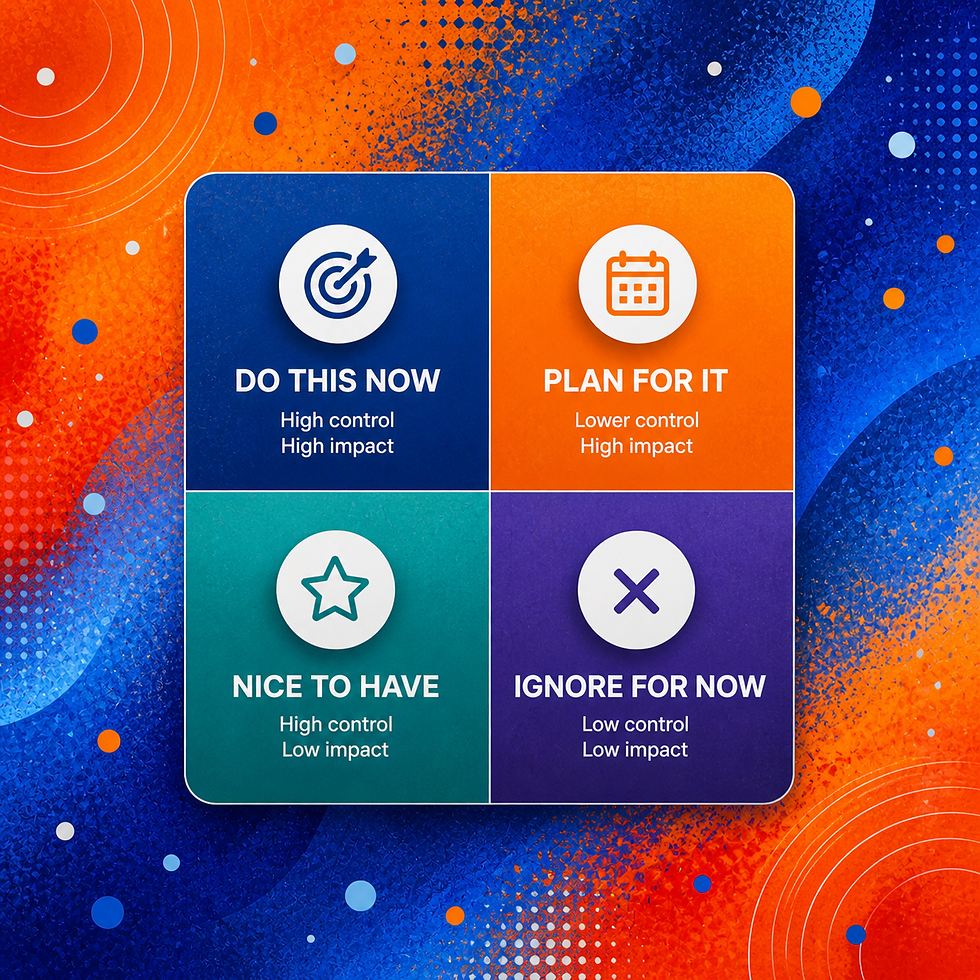
What can a small business actually control?
The KWS Control Matrix
The KWS Control Matrix shows you exactly where to focus your effort. It maps AEO actions across two dimensions - how much control you have, and how much impact they deliver. Start with the high-control, high-impact actions. Build from there. Most small businesses never need to go beyond that.
This is where effort turns into results.
Not every part of AEO carries the same weight - and not every part is within your control. The mistake most small businesses make is spreading effort too thinly, or focusing on signals that are difficult to influence.
The Control Matrix exists to solve that. It separates what matters into four clear areas based on impact and control, so you can focus your time where it actually moves the needle.
Small business websites are already appearing in AI search results - including brand new websites with no track record. The reason is simple: AI is answering specific questions, not running a popularity contest.
A well-structured page on a three-month-old website can outperform a poorly structured page on a ten-year-old domain - if it answers the question more clearly.
This is where to focus:
Do This Now - high control, high impact. These are within your reach, cost little or nothing, and have the most direct effect on visibility.
Plan For It - worth building towards, but not urgent. These signals compound over time.
Ignore For Now - real signals, but not where your effort belongs at this stage.
Start top-left. Work outwards.


Is this your customer?
A 17-year-old is on the sofa on a Tuesday evening, half watching TV, searching for a graphic design apprenticeship.
They search: "how do I find a graphic design apprenticeship in Yorkshire 2026"
ChatGPT gives them a structured answer and cites two local training providers whose websites clearly explained their programmes, entry requirements, and how to apply.
They fill in an expression of interest before bedtime. Neither provider had a marketing budget. Both had clear, specific, well-structured content.


What does good AEO content actually look like?
Good AEO content leads with the answer, uses question-based headings, keeps paragraphs short and self-contained, writes in sentences that can be quoted directly without interpretation, and stays consistently specific rather than broadly general.
Structure is not a design choice. It is the content. Every section should make sense on its own, without needing the rest of the page to be read first.
This is where most advice stops short.
Most AEO guidance focuses on surface-level changes - write clearly, add a FAQ section, structure your headings. That’s the entry point. It’s not what earns consistent citations.
What actually makes the difference is intentional structure. Content built around a specific customer question, with each section designed to stand on its own.
Think of every section as a standalone answer.
If someone lifted just that section out of your page and read it in isolation, would it still make sense? Would it still be useful? If yes, you are writing for AEO. If not - edit until it does.
This is the shift. You are not writing pages. You are writing answers that happen to live on pages.
And content means more than your website.
Blog posts, FAQs, podcast descriptions, email newsletters, LinkedIn articles - anywhere your business publishes words becomes a potential source of AI citations. The same principles apply everywhere.
The anatomy of AEO content - a roofing company worked example
Let's take Apex Roofing Solutions in Hull. Here's how the same information looks without AEO thinking, and with it.

The content elements - what each one does
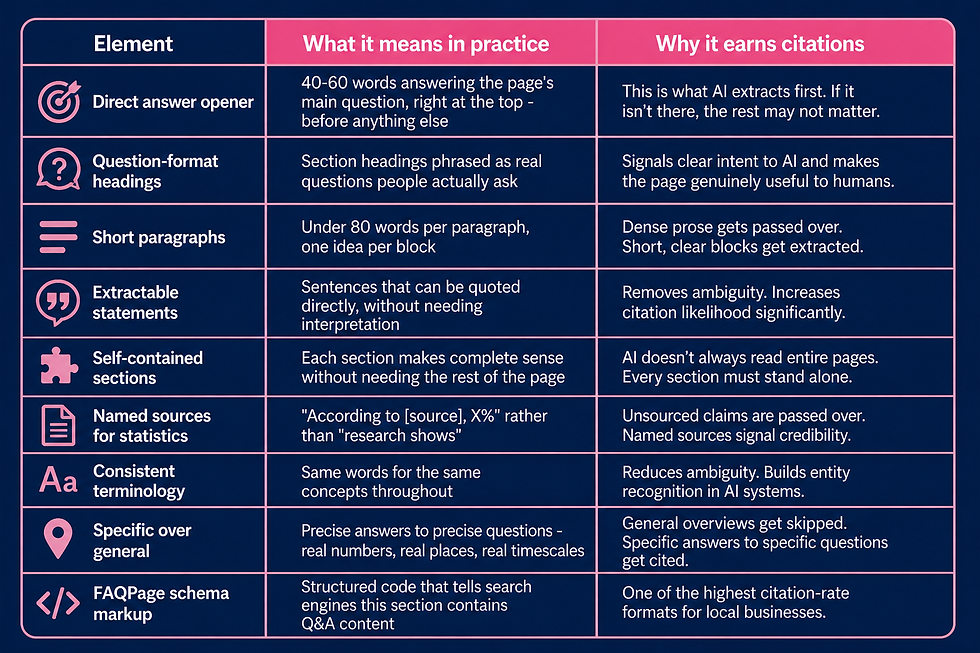
Take five minutes
Take one blog post or service page. Read the opening paragraph. Then ask: if someone asked me the question this page is supposed to answer, would this opening actually answer it? Directly? In plain English? In under 60 words? If not - that's your edit.
Then check the headings. Are any of them questions? Rewrite one. See how it feels.

Where do you start?
The KWS AEO priority checklist for small businesses
Start with what's fully in your control and delivers the fastest impact.
-
Rewrite your page openers to lead with direct answers.
-
Use question headings.
-
Complete your Google Business Profile. M
-
ake your business information identical everywhere it appears.
-
Put your name on your content.
These five actions cost nothing and can be done this week. Everything else builds from there.


What comes after AEO? Introducing AAO
AEO is about being found and cited by AI search systems. AAO - Assistive Agent Optimisation - is the next evolution (people instigate but don't actually do!).
It focuses on ensuring your business is not just cited, but actively recommended and chosen by autonomous AI agents: tools that don't just answer questions, but take actions on behalf of the people using them.
AEO gets you into the conversation. AAO makes sure you're the one chosen when an agent is given a task.
This is where things move beyond answers.
As of May 2026, the definition of AAO has settled into something both specific and important. Assistive Agent Optimisation is about preparing your business to be recommended and acted upon by AI agents that go beyond answering questions.
Think about what AI agents are already doing. Amazon's Rufus doesn’t just answer product questions. It makes recommendations and, through features like “Buy for Me”, can now complete a transaction on a third-party website on the customer’s behalf.
AI-powered assistants are starting to book appointments, compare service providers, and make enquiries. The next step is already in development across multiple platforms. AI that doesn’t just suggest which heating engineer to call, but makes the first contact.
This is where the distinction becomes clear.
AEO is about being cited in an answer.
AAO is about being chosen when an AI agent is tasked with finding, evaluating, and recommending a specific business.
The criteria shift slightly. Not just clarity and credibility, but completeness, consistency, clear pricing, and structured information that an AI agent can act on directly.
AEO and AAO are not competing ideas. They are sequential.
Build your AEO foundation first. The AAO layer builds on top of it naturally.
AAO is still a fast-moving and evolving area. The Rufus example shows where agent-led decisions are heading, but the full picture is still forming. This page will be updated as the landscape becomes clearer.
A dedicated page covering Assistive Agent Optimisation in full is coming soon. This section will link directly to it when live.
AEO and AAO: a plain English glossary
Every term used on this page, defined clearly
AAO (Assistive Agent Optimisation)
The next evolution beyond AEO. Optimising your business to be found, recommended, and acted upon by autonomous AI agents - tools that don't just answer questions, but take actions on behalf of users, such as booking appointments, making comparisons, or placing orders.
AEO (Answer Engine Optimisation)
The practice of structuring website content so that AI-powered search tools can identify it as the best answer to a customer's question and present it directly. Also written as Answer Engine Optimization (US spelling).
AI Overview
Google's AI-generated answer that appears at the very top of many search results pages - above paid adverts and the traditional list of ten links. Draws from several sources and cites them alongside the answer. Also known as Position Zero.
Answer engine
Any search tool that returns a direct, synthesised answer rather than a list of links. Includes Google AI Overviews, ChatGPT, Perplexity, Gemini, and voice assistants such as Siri and Alexa.
Authority signal
Any external factor that tells an AI system a source is trustworthy. Includes named authorship, backlinks, directory listings, reviews, and mentions in press or trade publications.
Citation
When an AI system references your website as the source for part of its answer. Earning citations in AI responses is the primary goal of AEO.
Content (in AEO context)
Everything your business publishes: website pages, blog posts, FAQs, podcast show notes, email newsletters, LinkedIn articles. Each piece is a potential source of AI citations.
Crawlability
Whether AI systems and search engines can access and read your website. Content behind login walls or incorrectly blocked by platform settings cannot be cited.
E-E-A-T
Experience, Expertise, Authoritativeness, Trustworthiness. Google's framework for evaluating content quality, which directly influences AEO citation likelihood.
Entity
A clearly defined thing AI systems can recognise and categorise - a business, a person, a location, a concept. Clear entity definition helps AI correctly identify and represent you.
Extractability
How easily an AI system can pull a clear, usable answer from your content. High extractability comes from short paragraphs, question headings, direct answers, and well-structured markup.
FAQPage schema
Structured data markup that tells search engines a section of your page contains questions and direct answers. One of the highest citation-rate content formats for local businesses.
GEO (Generative Engine Optimisation)
The broader discipline of optimising content across all generative AI platforms. AEO is the specific layer focused on direct answer citation. GEO covers the wider strategy.
Google Business Profile
A free tool that lets businesses manage how they appear in Google Search and Maps. A complete, active profile is one of the most powerful AEO signals for local businesses.
Knowledge Graph
Google's database of entities and their relationships. AI systems use it to verify facts about businesses and people. Appearing in it helps AI correctly understand and represent your business.
LocalBusiness schema
Structured data applied to a homepage that tells search engines the business name, location, type, and contact details in a format they can read directly.
NAP consistency
Name, Address, Phone number. These three details must be identical across every online listing for local businesses to maintain strong credibility signals.
Position Zero
The space at the very top of a Google results page, above the ten traditional links. Occupied by AI Overviews, featured snippets, or knowledge panels. The most visible position in search.
RAG (Retrieval-Augmented Generation)
The process most AI search tools use. The AI breaks a query into sub-questions, retrieves relevant web content, then generates an answer from what it finds. This is why structure and clarity matter so much.
Rufus
Amazon's AI shopping assistant, which can recommend products and complete purchases from third-party websites on a customer's behalf. An early and important example of Assistive Agent Optimisation in practice.
Schema markup
Structured code added to a website that helps search engines understand what the content is about. FAQPage, LocalBusiness, and Article schema are the most relevant for small businesses.
SEO (Search Engine Optimisation)
The practice of improving a website's visibility in traditional search results on Google and Bing. The foundation AEO builds on - not replaced by AEO, but no longer sufficient on its own.
Voice search
Queries spoken aloud to devices such as smartphones, smart speakers, or voice assistants. These are typically conversational and question-led - exactly what AEO content is built to answer.
Wikidata
A free, open knowledge base used by AI systems to verify that an entity exists and is what it claims to be. Creating an entry is one of the most achievable credibility signals for a small business.
Zero-click search
A search where the answer appears directly on the results page via an AI Overview, featured snippet, or voice response. Users then click one of the cited sources rather than browsing a list of links. Being a cited source is the new page one.
And there's more...
This page gives you the full picture. These take you further.
From the Web Wise blog
-
Zipping In - the blog series that tracks AEO and AI search developments as they happen
Listen
-
Reaching for Position Zero - the Kingstown Web Studio podcast covering AEO, AI search, and what it all means for small businesses
Services
-
Answer-Ready website design - websites built with AEO from the ground up
-
A Quick Guidance Call- the clearest way to find out where your website stands
-
Website Wizard - free diagnostic tool
Quick Summary (Tl;Dr)
AEO (Answer Engine Optimisation) is the practice of structuring your website so AI-powered search tools can understand, trust, and cite it as a direct answer.
The KWS Five C Framework - Clarity, Credibility, Context, Consistency, and Control - gives small businesses a practical, honest guide to what actually works.
The customer is the reason for all of it. Clarity beats budget. Specificity beats scale.

Page FAQs
What does AEO stand for?
AEO stands for Answer Engine Optimisation - also written as Answer Engine Optimization in the US. It is the practice of structuring website content so that AI-powered search tools, including Google AI Overviews, ChatGPT, and Perplexity, can select it as a direct answer to a customer's question and present it at the top of the results page.
What is the difference between AEO and SEO?
SEO (Search Engine Optimisation) helps your website appear in the traditional list of ten results on Google or Bing. AEO helps your content get cited as a direct answer in AI Overviews, ChatGPT responses, and voice search results. SEO is the foundation. AEO builds on top of it. Both matter, and good AEO practice strengthens your SEO at the same time.
Does a small business really need to worry about AEO?
Yes - and small businesses are better placed than most people assume. AI search rewards clarity and specificity, not budget and team size. A focused, well-structured small business website can appear in AI answers alongside much larger competitors, particularly for local and niche queries. The playing field is more level than it has been in twenty years.
What is AAO and how is it different from AEO?
AAO stands for Assistive Agent Optimisation. Where AEO focuses on being cited in AI answers, AAO focuses on being chosen and acted upon by autonomous AI agents that take actions on behalf of users - making enquiries, placing orders, or booking appointments. AEO first. AAO builds naturally on top of it. As of May 2026, AAO is still an evolving discipline.
Where should a small business start with AEO?
Start with what is fully in your control: rewrite your page openers to lead with direct answers, use question-format headings, make your business information identical across every platform, complete your Google Business Profile, and add your name as author to your content. These five actions cost nothing and have immediate impact.
Does my website platform affect my AEO?
Less than you might think. Platforms like Wix, WordPress, and Squarespace all handle the technical basics well enough for AEO purposes - including server-side rendering, sitemap submission, and schema markup support. What determines your AEO performance is how your content is written and structured, not which platform it sits on.
Sources
This page and the KWS Five C Framework draw on wide research across the AEO and AI search landscape.
Sources consulted include:
Google Search - AI Overviews, People Also Ask data, and Position Zero behaviour observed directly
Ubersuggest - keyword research and search volume data for AEO-related terms
AnswerThePublic - question mapping and search intent research
LinkedIn AEO and AI search community - multiple contributors across the digital marketing and search community
Forbes, HubSpot, Coursera, CXL, Reddit - reviewed as part of the broader AEO content landscape
Gartner, Adobe, McKinsey, HubSpot Consumer Trends Reports - for AI search adoption and market data cited in this page
CNBC, TechCrunch, PYMNTS, Modern Retail, The Drum, Tinuiti, Nova - for Amazon Rufus and agentic commerce reporting
AMALYTIX - Amazon Rufus Guide 2026, for detailed Rufus feature analysis
Original frameworks
The KWS Five C Framework (Clarity, Credibility, Context, Consistency, Control), the Customer-Centre Satellite Model, the Control Matrix, and the Content Model are original frameworks developed by Kingstown Web Studio, informed by the research above and by direct observation of AI search behaviour across client websites.
Current as of May 2026. This page will be reviewed and updated as the AEO and AAO landscape develops.